
Where are you on your AI Training Programme journey?
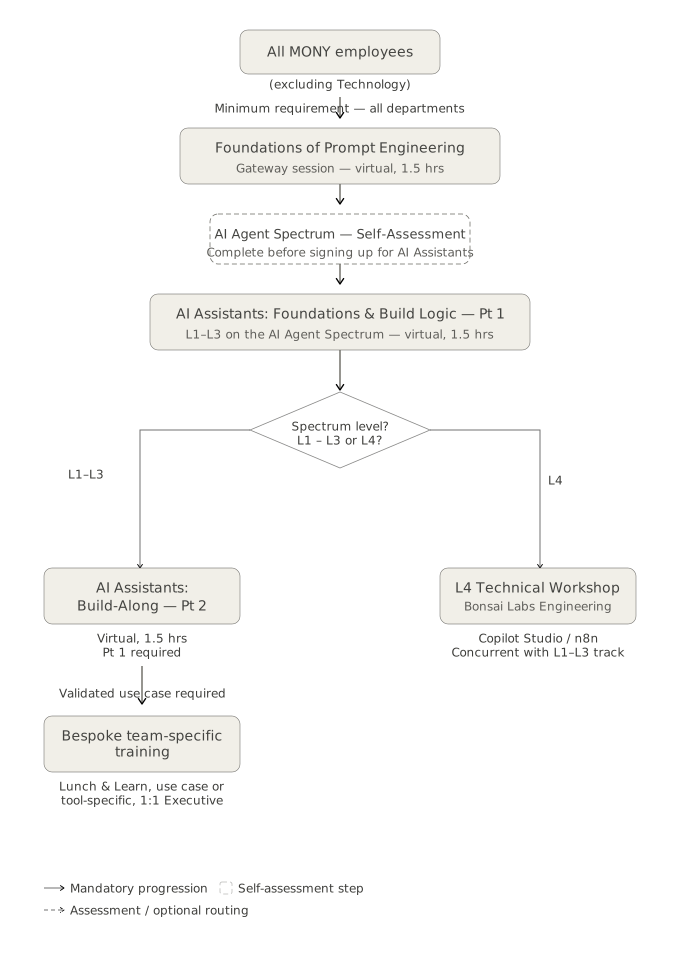
The programme is staged. Everyone enters through Foundations of Prompt Engineering, builds through the AI Assistants sessions, then forks into the track that fits — with bespoke team-specific training to follow.
Entry point
Foundations of Prompt Engineering
The starting point for everyone at MONY Group, across all departments. Foundations is a minimum requirement for the programme — completing it is what opens the door to everything that follows.
Colleagues from Technology are welcome to join any session at any stage, and can pick up the programme at whichever point makes most sense for where they already are.
Stage 1
AI Assistants: Foundations & Build Logic (Part 1)
Part 1 builds directly on Foundations. It introduces the thinking behind building a structured AI Assistant — which is a different kind of task from one-off prompting — and covers the four Build Logic components: Description, Instructions, Knowledge, and Capabilities. The session includes hands-on challenges and demonstrations using both Copilot Agent Builder and ChatGPT CustomGPTs.
Part 1 also introduces the 3 × A's of AI — Augmentation, Automation, and Agents — with a guided challenge via the Agent Arena.
This session is designed for employees at L1, L2, and L3 on the AI Agent Spectrum. L4 employees are welcome to attend, though it isn't a requirement for them.
Stage 2 — Pathway fork
L1–L3 track — AI Assistants: Build-Along (Part 2)
A hands-on build session where participants take the Build Logic from Part 1 and apply it to a real, validated MONY Group use case — something drawn from actual work, not a generic exercise. Completing Part 1 is a prerequisite.
L4 track — Technical Workshop (Bonsai Labs Engineering)
L4 employees move directly into a technical workshop focused on building in Copilot Studio or automating with n8n, depending on their use case and available tooling. This track runs at the same time as the L1–L3 programme, so there's no waiting around for the broader cohort to catch up.
Beyond Stage 2
Bespoke team-specific training
Available following completion of Stage 2, once a team or individual has a validated use case ready to build on. Formats include in-person Lunch & Learn sessions, use case or tool-specific workshops, and 1:1 executive training.
Self-assessment
The AI Agent Spectrum
A self-assessment tool designed to help colleagues identify the right starting point before signing up to a session. Four levels — L1 Observer through to L4 Architect — each describing a different stage of experience with building and configuring AI Assistants in Copilot Agent Builder and ChatGPT's CustomGPTs.
The Spectrum is not a test and there are no right or wrong answers. Its purpose is to make sure colleagues are in the session that will be most useful for them — not too familiar to be a repeat of what they already know, and not so advanced that it moves too quickly.
How the Spectrum determines your route
L1, L2, and L3 are routed to Part 1 — AI Assistants: Foundations & Build Logic, followed by Part 2 — AI Assistants: Build-Along. These sessions run in sequence, with a deliberate gap between them to allow colleagues to identify and validate a use case before the Build-Along.
L4 participants — those already building AI Assistants regularly, iterating independently, and thinking about build logic across multiple use cases — are not routed through Parts 1 and 2. Their next step is the L4 Technical Workshop delivered by the Bonsai Labs engineering team, focused on agent building in Copilot Studio or automation building with n8n. The L4 track runs concurrently with Parts 1 and/or 2, so there is no waiting period.
L1
Observer
You are aware of AI Assistants — CustomGPTs and Copilot Agents — and may have used one that someone else built, but you haven't yet attempted to build or configure one yourself.
Example behaviour
You've used a pre-built Agent in Microsoft Copilot to search for internal documents, or interacted with a shared CustomGPT your team set up — but when asked how it was built or what instructions it runs on, you wouldn't be sure.
What this means for you
You're in the right place to start learning. The session will walk you through the build logic step by step — you don't need to have built anything before to get full value from it.
L2
Explorer
You've had a go at configuring an Agent or CustomGPT using the guided interface. You produced something that worked, at least partially — but the output was inconsistent, the instructions felt uncertain, or you weren't fully sure why it behaved the way it did.
Example behaviour
You opened Copilot Agent Builder or the CustomGPT editor, filled in some instructions, and tested it a few times. The responses were sometimes useful, but you found yourself re-prompting a lot, or the Agent drifted from what you intended.
What this means for you
You've taken the most important first step. Foundations will give you the framework behind what you've already tried — the difference between an Agent that drifts and one that performs consistently.
L3
Builder
You've built an Agent or CustomGPT with a defined purpose and a clear intended audience. You've developed build logic thoughtfully, tested how it behaves, and made deliberate adjustments based on what you observed.
Example behaviour
You built a CustomGPT for a specific team task — for example, drafting structured communications from a brief — gave it detailed instructions, uploaded relevant knowledge, and tested with realistic prompts. When the output wasn't right, you went back into the instructions to fix the cause rather than re-prompting.
What this means for you
You're operating at a level where Build Logic will deepen rather than introduce. You'll work on refining instruction quality, applying guardrails deliberately, and thinking through how your Agent's design prevents hallucination and scope creep.
L4
Architect
You think about Agents at a design level — not just what a single Agent should do, but how it fits into a wider workflow, what guardrails it needs, and how the same build logic applies across multiple use cases or teams.
Example behaviour
You've built more than one Agent for different purposes, or structured an Agent that multiple colleagues use and rely on. You've considered what the Agent must not do as carefully as what it should do, and started thinking about how Agent capability could be applied beyond your own immediate work.
What this means for you
Build Logic will work as structured consolidation of what you've already developed instinctively. You'll benefit most from guardrails by design, hallucination reduction, the differences between platforms — and from the build challenge, which will test the rigour of your current approach.